2023년 5월 29일 월요일

The Message of New Buddhism to All the Buddhists in Korea and the World on the New Year Day of 2014.


The Message of New Buddhism

to All the Buddhists in Korea and the World

on the New Year Day of 2014.


I. Why Must It Be the New and

the Vulture Peak Buddhism?


The Vulture Peak Buddhism is the new Buddhism of the cosmic truth to open the age of orthodox dharma by subverting the current mislead and diminished Buddhism of the era of decline of the illustrious doctrine founded by the Great Master Gwangmyeong Mandeok, Venerable Kasyapa, and the Great Master Jajae Manhyeon, Venerable Ananda, who have succeeded the dharma lineage of Buddha.


1. The Vulture Peak Buddhism Is the Orthodox

Buddhism Which Succeeded

the Dharma Lineage of Buddha.


1) Venerable Kasyapa and Ananda Who Were Entrusted

the Orthodox Dharma by Buddha.


Buddha entrusted the dharma lineage to the Lord's disciples Kasyapa and Ananda at the time of the Vulture Peak congregation. The transmission of the dharma robe by the Lord to Mahakasyapa at the Vulture Peak congregation; the three occasions of transmission of mind to mind from


Buddha to Kasyapa; and the testimony of the transmission of the orthodox dharma discoursed in the Anguttra-nikaya all support the truth of transmission of the dharma to the two venerable disciples by the Buddha.

In the Mahaparinirvana Sutra of the Mahayana Buddhism, Buddha discoursed to the disciples, "As I have transmitted all the illustrious laws I have discoursed to Mahakasyapa, he will be a great prop for all of you to rely on in the future." In the Sutra of Great Compassion, Buddha also commanded to Ananda, "I am transmitting the unexcelled, perfect enlightenment I have attained through incalculable billions of eons of time and the stores of great law to you now. Therefore, don't forget to expound them without amiss so that they will not be terminated."


2) The Lawful Disciples of the Orthodox Dharma Gwangmyeong Mandeok, Venerable Kasyapa, and the Great Master Jajae Manhyeon, Venerable Ananda, Founded the Vulture Peak Buddhism.


The Most Honored Buddha is abiding at Hyeonjisa Temple manifested in Buddha-body at the time of the 21st Century, 2,600 years after the entrustment of the orthodox dharma so that the Lord could help the Venerable Kasyapa and Ananda attain the Buddhahood and then take them along with Him. Another reason the Lord decided to abide at Hyeonjisa Temple as the permanent abode is to open the new Buddhism of orthodox dharma.

Both Gwangmyeong Mandeok, Venerable Kasyapa at the time of the Vulture Peak congregation, and the Great Master Jajae Manhyeon, Venerable Ananda at the time of the Vulture Peak congregation, attained the Buddhahood in Korea with the help of the Lord Buddha. The Great Master Gwangmyeong Mandeok also became the crown prince and succeeded the unsurpassed law of the Buddha in the status of enlightened Buddha.

With the Great Master Jajae Manhyeon, the crown prince Venerable Ananda, the Great Master also founded the Vulture Peak Buddhism on the 15th day of the sixth moon in lunar calendar 2551 (BE) to open the new age of orthodox dharma. On this day, the Great Master Gwangmyeong Mandeok transmitted the dharma lineage of the Buddha to the Great Master


Jajae Manhyeon and bequeathed the dharma robe of thirty-three patches as a token.


3) The Secret of Three Triangular Dots of the Letter (伊字三點 ∴) of the Nirvana Sutra and the Advent of the Orthodox Dharma.


About the secrets of Buddha's renunciation of the mundane world and the advent of the orthodox dharma, we can find them in the Mahaparinirvana Sutra, the Flower Garland Sutra, Anguttrara-nikaya, or the Graded Collection, etc. The secret of the three triangular dots of the letter we find in the Longevity Section of Mahaparinirvana means that three Buddhas who are all equipped with Triple Body--Dharmakaya, or the body of pure being or essence, Sambhogakaya, or the body of manifestation of the universal Buddha-essence in symbolic form, and Nirmanakaya, or the body of transformation--will manifest in the world.

However, the truth is that the two of the three Buddhas manifesting in the world are the Great Master Gwangmyeong Mandeok and the Great Master Jajae Manhyeon, the successors of the orthodox dharma of the Buddha.

About the orthodox dharma, the Mahaparinirvana expounds that the indoctrinations of Agama are the 'half-lettered teaching (半字敎)' which is only the fundamental teachings, and in the future, 'full-lettered teaching (滿字敎)', that is the higher level of teachings will emerge. This is what we call the new Vulture Peak Buddhism of the 21st Century.


2. The Vulture Peak Buddhism Is the New Buddhism

that Overturned the Mislead and Subsided Current Buddhism.


The common problems of current mislead and subsided Buddhism in the world are the triple non-existence of Buddhism: the non-existence of Buddha, the non-existence of the substance of human soul, and the non-existence of the way of practice to become a Bodhisattva, and the fundamental reason of all this is the misleading interpretation of 'non-self'.


1) The Current Buddhism of the World

Is the Buddhism without Buddha.


Buddha subsists as such in the absolute reality of non-self beyond the time and space and also beyond existence and nonexistence. However, the current Buddhism does not know the subsistence of living personality of Buddha, who is actually Smbhogakaya, or the manifestation of the universal Buddha-essence.

They say the mind is Buddha. They think the Buddha who entered nirvana in India 2,600 years ago returned to emptiness and exterminated. The Lotus Sutra, The Sutra of Golden Light, and some other important Mahayana sutras and treatises confirm the subsistence of Buddha, yet they do not listen to them, and this is the actual circumstances of the present Buddhism of the evil time of the five turbidities. The Buddhism that does not know Buddha and does no know the Lord's power of deliverance is not Buddhism.


2) The Established Buddhism Misleads the Theory  

of 'Non-self' and Denies the Substance of Soul.


The doctrine of 'non-self (無我)' of Buddha means nonexistence of the substance of all the phenomenal world, and its practical meaning is, of course, renunciation of "the attachment of self" and "the greedy mind." However, the established Buddhism misinterprets it and then misleads the people by denying the substance of human soul which is the subsistence of the realm of noumenon beyond the phenomenal world.

They claim that as there is no substance of self, there must not be a subject or the nucleus of transmigration. On the basis of this misinterpretation, to solve the contradiction of "the theory of 'non-self' and the nucleus of transmigration," they developed diverse theories for more than 2,000 years, but none of the nonsensical theories were convincing. What's more, this mislead theory of 'non-self' became the principal offender of the deterioration of Buddhism.

If you deny the substance of man, the nucleus of transmigration and enlightenment, and Buddha and Bodhisattvas, there is no reason for Buddhism to exist. I once again emphasize that the substance of soul which is also the substance of human being subsists and the nucleus of transmigration is none other than the substance of soul.


3) There Is No System of Practice to Become

Buddha and Bodhisattvas

in the Current Buddhism of the World.


The objective of vipassana meditation of the southern or Hinayana Buddhism is to become an arhat. As it relies entirely on the self-power, there is no way to become a Buddha or a Bodhisattva. On the other hand, the meditation practice of the northern Seon or Zen Buddhism is not the traditional practice of Buddhism. Especially, Hwadu contemplation meditation of the Korean Buddhism is the Outside Way practice that is not in the Buddhist sutra.

The meaning of doctrine such as, "Seeing self-nature and attaining the Buddhahood." or "Mind itself is the Buddha." is a foolish talk which could not distinguish attaining the Buddhahood from realizing the self-nature. The catch phrase of the Tibetan Buddhism, "This body itself is Buddha," one of the three practices of the triple secret (三密), with which one can, they say, attain the Buddhahood, is also a foolish logic that blaspheme the Buddha-body and belittle Buddhism.

The Buddha-body, or the Body of Bliss is realized in the ultimate reality in selflessness when one is completely unified with the original nature of the universe, not on the level of the practice of the triple secret of the Tibetan Esoteric practice. The nature of yoga, one of the three steps of practice of the formless yoga tantra, is the practice of the Outside Way. I want to tell you that the only way to become a Buddha or a Bodhisattva is invoking the name of Buddha.


3. The Vulture Peak Buddhism Is the Teaching

of Sambhogakaya in the Present Age of 21st Century.


Sakyamuni Buddha manifested in the physical body in India 2,600 years ago to plant the seed of Buddhism and then expounded Agama, the fundamental teachings of Buddhism. About five to six hundred years since then, Buddha sent His avatar such as Manjusri Bodhisattva to the mundane world to edit the Mahayanas sutras and taught more elevated teachings than at the time of the Vulture Peak congregation.

And then again in the 21st Century, the Lord incarnated in Sambhogakaya, or the Body of Bliss, in Korea to guide the Great Master Gwangmyeong Mandeok and the Great Master Jajae Manhyeon so that they could attain the Buddhahood, and then transmitted the optimal level of consumate teaching through two great masters. Therefore, the Vulture Peak Buddhism is the Buddha's teaching in the present age of the 21st Century.


2023년 2월 18일 토요일

I open a new chapter of new Buddhism / page19~ page 23


 I open a new chapter of new Buddhism


I bear witness that I have passed2 the Path of a Bodhisattva (the

examination of teaching and saving Bodhisattvas)of the family3 of the true 

Dharma of the Buddha, and that the Body of the Buddha is made of the 

Immeasurable Light


I, kasyapa Gwangmyong Manduk, personally met the

Buddha who abides in true suchness in the Absolute Realm of

Constant Quiescence Light, and have put the vivid teachings 

that I have heard from him together with Ananda Jajae

Manhyon here in the 21st Century Buddha's Message I, 

II. With these teachings, I wish to open the first chapter of 

new Buddhism.


2 By ceaselessly pursuing bodhi (enlightenment) on the one hand and 

by practicing the actions of a Bodhisattva over countless kalpas of lives on

the other hand, when one reaches ultimately the level at which one can

achieve Buddhahood, one will be confirmed as possessing the capacity of

a Buddha from the Buddha.  Afterwards, one must cultivate the ability

(wisdom, compassion, patience, observation of precepts, Samadhi of deep

concentration) to teach and save heavenly beings, holy multitude arhats,

undefiled great arhats, heavenly goddesses, preparatory Bodhisattvas, and

Bodhisattvas and must pass a final examination of no-self to become a

perfect Buddha. (If one is to become a doctor, it is the same as having to

study and finally graduate in order to become a qualified medical 

specialist.)


3The family of the true Dharma of the Buddha includes the Five

Tathagata Buddhas with our King of Buddhism, Buddha the World-

Honoured, at the top, numerous Buddhas in the Three Realms,

Bodhisattvas, holy multitude arhats, and all Buddhist sentient beings in the 

six realms who have taken refuge in the Buddha.


                                          I open a new chapter of new Buddhism _ 19


It is 2600 years since the Buddha who came to the land of 

India as the Responsive Transformation Body departed and all

were filled with deep sadness as if the sky had fallen.  Thus

how can I express in writing and speech the overflowing joy

and the deep emotions that I experience when I meet the

Reward Body Buddha of Sakyamuni Buddha again in the land

of South Korea who is in the form of human character made

of the Immeasurable Light?  That I can make an offering to

him every day as a Buddha who has succeeded the Dharma,

and that I can also be with him all the time ?

  I am serving the Buddha like this all the time, but the

present Buddhist circles say that there is no Buddha and tend

not to believe in even transmigration in the six realms, and

their precepts of purity have broken down.  In this latter

Dharma time of an evil period of the five defilements, the 

teaching of the Buddha has been distorted too much and has

also become diminutive.

  I, Gwangmyong Manduk, want to take as the first teaching

of new Buddhism, Yongsan Buddhism, by witnessing the

existence of the Buddha and his great real substance based on

my experiences and views as a Buddha who possesses

the Three Bodies.  It is deeply regrettable that  I am unable to

open to our Buddhists the Dharma secrets of the realm of the

Buddha and my practice diary for lack of space.  I will

reveal here the vivid course of passing through difficult

gateways that I have experienced while taking the qualifying

examinations of various stages for teaching and saving

heavenly beings, holy multitude arhats, undefiled great arhats, 

heavenly goddesses, preparatory Bodhisattvas, and 

Bodhisattvas to become a perfect Buddha after having

attained Buddhahood from the Buddha.  I want to use as the


20_The 21st Century Buddha's message 1


preface of this book the course of thses qualifying

examinations, and to bear witness to the Buddha Body of the

Buddha made of the Immeasurable Light.


1.  Earnest practice in To-gool at Amsa-dong in Seoul for three

years4(In ancient times, the cave was called To-gool and whilst it is no

longer a cave, the name 'To-gool' is now used to refer to a place where a 

practitioner practices intensively.)


 I went into a bold and vigorous practice, prepared all the

while for death, putting a sharp and glittering knife in front of

me from the beginning.  I succeeded in moving an image of

the Buddha in Seokguram Grotto onto the wall in 100 days.

I will not write here about the process of desperate practice I

took before being confirmed as a Buddha by entering a deep

complete concentration, seeing the Immeasurable Light, and

meeting the Buddha in person.

  I took tough examinations over and over again in order to

qualify as being able to teach and save heavenly beings5, holy


 4 From the beginning, the way of my practicing chanting the Buddha's

name was to first read the Diamond Sutra once, recite a Buddha's dharani

three times and then chant the sacred name of 'Sokkamonibul.' I was

taught this by a Buddha (through exquisite and sonorous voice of 

Ksitigarbha Bodhisattva coming from the empty space; Gong-

cheong denotes an exquisite and sonorous voice of a Buddha or a

Bodhisattva coming from the empty space when a practitinoer is in the

state of a perfect Samadhi).  I call this 'the recitation of the sacred name

of the Buddha with the practice of the Noble Eightfold Path'- this is to

ask you to become a Bodhisattva by receiving empowerment of the

Buddha and to chant the sacred name of the Buddha, observing the 

precepts of the Dharma to attain Buddhahood.


5 This denotes the six heavens in the realm of desires.  When these

are looked at in more detail, there are the heavens of 54 levels.  When

one puts the five precepts and ten virtues into practice, one can be reborn 

in one of the heavens.


                                                       I open a new chapter of new Buddhism_  21


multitudes, undefiled great arhats and heavenly goddesses

after having been confirmed as a Buddha.  In this process, I

came to know that there are 54 levels of heavens, and there is

King Sakra who teaches and saves the kings of the respective

heavens.  My ability to teach and save all of them has been

confirmed.  I competed with holy multitudes,6 undefiled great

arhats and heavenly goddesses (of the Pure Land of Heavenly

Goddesses7), and Buddha the World-Honoured has confirmed

my ability to prevail and supervise them.


2.  Life in To-gool at Bo-gwang-dong(Itae-won) for three years


  I entered various kinds of Samadhi through bold and

vigorous practice in order to pass the examinations of

preparatory Bodhisattva8 and the Path of a Bodhisattva(an

examination of teaching and saving Bodhisattvas).  The examination

at this time was the practice of mastering and learning all the

Dharma of 'having no I and living for the benefit of others.'


  6It means the holy multitude arhats.  They are the beings of heaven of

the Form Realm and the Formless Realm who have entered the rank of a

saint.  One can be born in that heaven when one can enter deep and

complete concentration.


  7This is the realm of all women saints who serve BAUDDHAS, AND WHERE

they let rain of flowers be sprinkled when there is an event involving a 

Buddha.


  8This is the heaven of a Pure Land which is above the Pure Land of

Heavenly Goddesses and is immediately below the Realm of UItimate

Bliss where a preparatory Bodhisattva can be reborn.


22 _ The 21st Century Buddha's Message 1


  Buddha the World-Honoured, Sakyamuni Buddha, and the

Sixteen Teachers 9 sat on their respective diamond thrones,

and the examination given over several hours made me

extremely strained and I  was faced with various difficulties.

  I entered Samadhi of recitations10 of the Noble Eightfold

Path for 10 - 13 hours, sometimes 18 hours, each time with

painstaking preparedness for death.


  Dark barley tea in a big kettle was almost the only thing I

ingested, and I kept missing meals over many day, so I could

not relieve myself.  I could not tell how emaciated I was

because of the daily practice that made me exhausted and

tired, and I also spent time being completely absorbed in

perfect Samadhi almost without soeeping by virtue of Samadhi.

But my physical strength was maintained by virtue of the

awesome spiritual powers of the Buddha.


9 16 Buddhas worked hard in the noble work of teaching Gwangmyong

Manduk aND jajae Manhyon to become Buddhas.  They are Sakyamuni

Buddha, the Five Tathagata Buddhas and the most -prominent Buddhas

among all Buddhas in the Three Realms - Manjushri, Samantabhadra,

Avalokiteshvara, Mahasthamaprapta, Maitreya, Ksitigarbha, Mountain

King Buddha, Stars Ruling Tathagata Buddha, Myongsang Buddha, Hwa-

gwang Buddha, Daewon Myo-eum-wang Buddha.


10 Samadhi through recitation of the Buddha's name that I have

mentioned here has a great difference in depth from pratyutpanna Samadhi

That Samadhi is a profound stage of practice that one can

meet the Buddhas fof the Three Realms.  One meets the Buddha who

eliminates one's karmic hindrance, removes the heavenly maras that have

been possessing him, protects one from various mara-hindrances, leads

one to Samadhi, provides one with wisdom, eradicate the root of the three

poisons of greed, anger(hatred), and makes the body (the four spiritual

bodies) change to the spiritual bodies of light(the Buddha Body) by

pouring the Immeasurable Light. 


                                                I open a net chapter of new Buddhism- 23


2023년 2월 15일 수요일

Background on the conception of the shaven-headed image of the Buddha


Background on the conception of the shaven-headed image of the Buddha


 In the early days of Buddhism, the creation of statues of the Buddha’s likeness was prohibited.


The Gandhara Region became the grounds on which Buddhism first flourished. These lands were ruled by the Kushan Emperor, Kanishka the Great (127-150 AD), of the Kushan Tribe, which established the Kushan Empire. It was King Kanishka who spread the teachings of Mahayana Buddhism from Gandhara to China by means of the Silk Road. With the dissemination of Mahayana Buddhist thought too came the methods of Buddhist prayer and practice, along with the reading of the Buddhist sutras.


Gandhara / the Roman Empire / the Kushan Empire / the Later Han Empire


In the ancient days of Buddhism — some 2,200 years ago — visual depictions of the Buddha were strictly prohibited. As such, the creation of statues of the Buddha was not allowed. However, ancient peoples had a lasting desire to lay their eyes on an image of the Buddha.


Owing to this longing — and breaking a taboo held for 500 years — a statue of Buddha was finally born.


Sirkap (now an archaeological site in Pakistan) was an ancient city in the eastern Gandhara region. Alexander the Great, conqueror of all Eurasia, was responsible for the city’s planning and development, intending it as a Greek settlement. One hundred years after Sirkap’s construction, the city fell under the rule of the Kushan Empire following their conquest of the Gandhara region. Consequently, Buddhism was introduced to the Greek population residing there.
 

As a result, one of the earliest-known statues of the Buddha — the Seated Buddha from Gandhara(excavated in the west end of Gandhara) — features an amalgamation of Greek and Asiatic artistic styles, and was influenced by Ancient Greek sculpture. Similar to the features common in Hellenistic sculptures, the Seated Buddha from Gandhara was carved with large, long ears and curly hair held up in a topknot. It is postulated that the topknot hairstyle appearing on this statue eventually metamorphosed in China into the crown-like protuberance atop the Buddha’s head that is common in modern depictions. Such it was that in Gandhara, the lands where ancient Buddhism flourished — breaking a 500-year taboo — a figure of the Buddha was born.


[The Seated Buddha from Gandhara]


When the Buddha renounced secular life to become a monk, he cut off his hair, shaving his head bald. This fact is recorded in many sutras.


In the Causality of Past and Present Sutra (過去現在因果経), Vol. 2, Prince Siddhartha says, “Now that I have cut my hair and beard, please let me cut off all defilements of mind and sinful hindrances.” Responding to this action, Indra, King of the Devas, took the hair from Siddhartha and disappeared, after which many heavenly beings sprinkled incense powder and flowers upon Siddhartha from the air, praising him and saying, “Excellent, excellent.”


The Vasala Sutta (Sutta Nipata 1:7) contains a scene in which a brahmin, seeing the Buddha come to his residence for alms, speaks the words, “Stay there, you shaveling! Stay there, you wretched monk!”


According to Vinaya Pitaka, Vol. 4 (Mahavagga), the Buddha, seeing a monk with long hair, spoke to him, “Cut your hair and beard off of your own doing, or have them cut off.”


In the Samannaphala Sutta (Digha Nikaya Vol. 2), during the dialogue with King Ajatashatru, the Buddha said that to become a Buddhist monk is to cut off one’s hair and beard, clothe themselves in orange-colored robes, and go forth from their household to cultivate Enlightenment.


As the Buddha renounced not only his royal status as a prince, his wealth, and his honor, but even his hair — truly a part of his own body — shaving off one’s hair is recognized as a holy and precious action. Owing to this display of sacrifice made by the Buddha, the shaving of one’s hair has become a Buddhist precept within monkhood.


[The statue of the First Turning of the Wheel of the Illustrious Law (初轉法輪)]


Curly hair and a protuberance on the crown of the Buddha are typical features of a Buddha statue.


      Throughout the history of Buddhism, Buddha statues have been made with the Buddha possessing curly or wavy hair, and a hairstyle similar to a conch-like shape, or a topknot. Buddhist scholars have theorized that it would have been difficult to apply the shaved head of a sinner to the Buddha’s image in India and that the current unique depiction of the Buddha was borne from the likeness of the Greek-influenced Gandhara Buddha statue


      According to an alternative theory, the historical image of the Buddha was formed based on a passage found in the sutras that states that the Buddha — with his thirty-two physical marks — possesses conch-like hair that is dark blue and worn wrapped up on the right side of his head.


According to Buddhist texts, the thirty-two marks of a holy man — or the Wheel-turning Monarch — documented in Ancient Indian writings are a symbol of holiness, and that the Buddha was born with these marks upon him. There is a view that the Buddha is often expressed in imagery as possessing curly hair and a protuberance on his crown to symbolize the Buddha’s sacred and great appearance of the thirty-two major and eighty minor marks of a holy man.


The appearance of the Buddha is recorded in detail in the following texts: Majjhima-nikaya, Vol. 11; the Sutra of Past and Present Causes and Effects, Vol. 1; the Abhiniṣkramaṇa Sūtra, Vol. 9 (Sutra of the Great Renunciation); the Lalitavistara Sutra, Vol. 3 (Sutra of Extensive Play); the Mañjuśrī-paripṛcchā Sutra; etc.


The Statue of Seokguram Grotto

Various images of Buddha as found across Southeast Asia


The Buddhas in the Absolute Realm in Selflessness all have their heads shaved.


The Buddha-recitation Samadhi, the practice diary of Great Monk Gwangmyong Manduk, describes in detail the appearance of the Buddha as follows:


“A monk wearing a golden, long-sleeved robe and a red kasaya robe, with his hair shaved and holding a staff with rings suspended from it in his hand, came forth from the Buddha statue.”


“Shakyamuni Buddha spoke to me, saying, "The Triad Buddha from the Western Pure Land of Utmost Bliss has come here. Give your greetings to them." I prostrated before them wholeheartedly. The Triad Buddha all wore golden, long-sleeved robes and red kasaya robes; all had their heads shaved."


All those she met in Samadhi were Buddhas, and all appeared before her with their heads shaved.


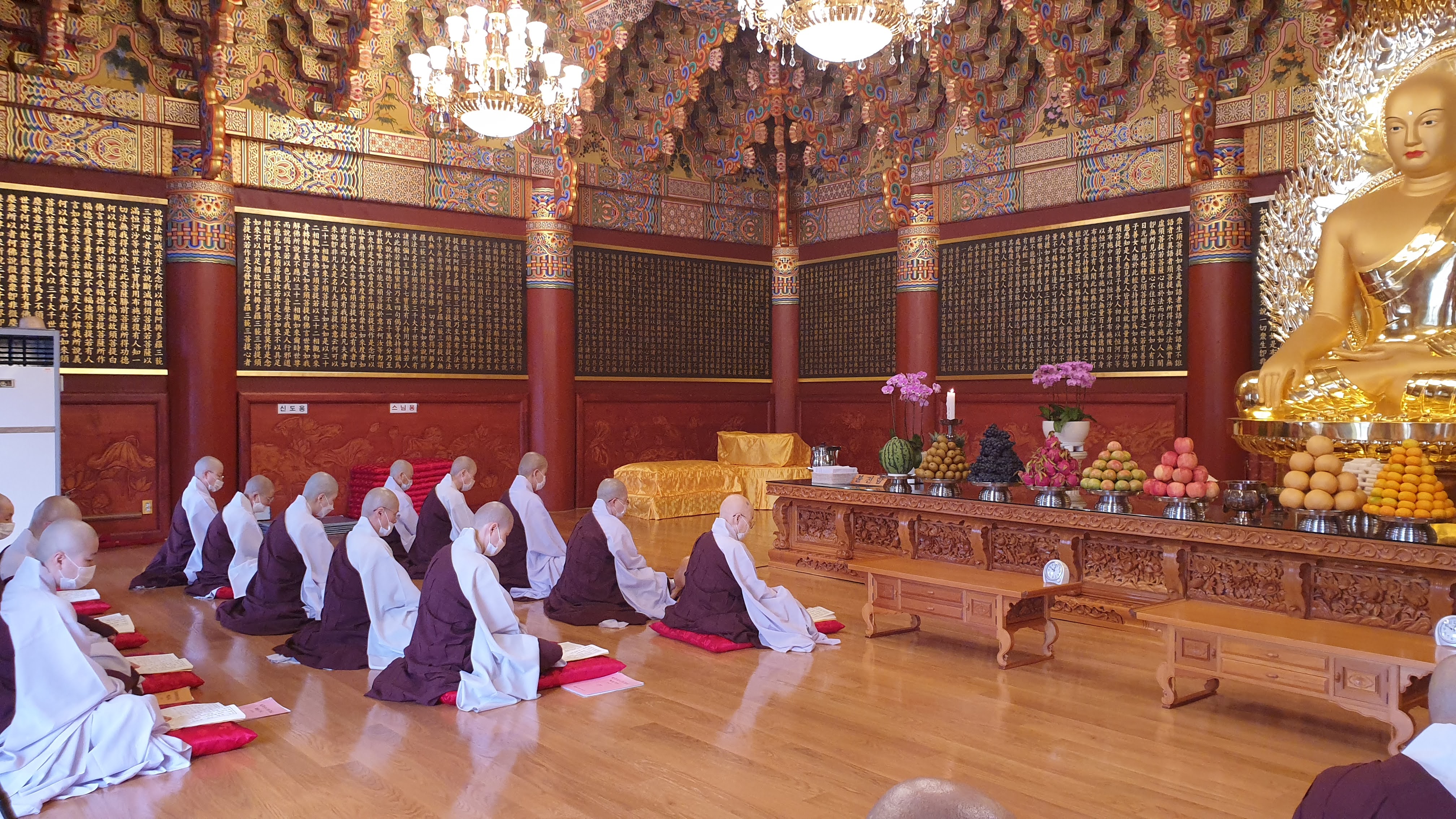
Hyonjisa enshrines the image of the Buddha with a shaved head, an image which has never existed in any temples or countries of the Saha world.


All images of the Buddha found in the statues and paintings of Hyonjisa — those proclaiming that the Buddha abides in the Absolute Realm — have their heads cleanly shaved. The notion of the “shaven-headed Buddha” speaks to the profound thought of Yongsan Buddhism, the New Buddhism of the 21st century. It will be of supreme merit and virtue to meet, praise, worship, and make offerings to such genuine Buddhas.